
Please enjoy these two articles from Spandan (Michael McCann). The first, a beautiful poetic text regarding Symbols and meanings. The second, equally poetic, explores the infusion of the mantra OM through the human body.
YOGA AT LUGHNASA
“We shall show them Our signs on the horizon and in themselves…”
(Koran, 41:53)
One of the beautiful gifts of Yoga is that it leads us back to a world of symbols, of myth and meaning. We begin to feel intuitively what lies behind so-called things and facts and indeed sense the whisperings and reverberations of worlds that exist behind or above this world. The traditional metaphysics of Tantra and many other cultures teach that everything is a symbol of something higher than itself, reflecting the successive worlds (lokas) which are created as the Word (OM or Logos) vibrates downwards from the Absolute Reality.
Yoga is rooted in a very ancient vision of the world, beyond the reach of classical history, and enshrined in the myths of ancient scriptures, such as the Vedas and Puranas of India, the hermetic texts, and the mysterious writings of the Old Testament. The sages of yore saw directly (darshan) that everything is a symbol, because their vision was pure, and because they saw with the “eye of the heart”. Today when we speak a word, that word will bring to the mind an image. It is said that in earlier ages, such as the Satya Yuga (Golden Age), the levels of reality were so transparent, that when a person saw an object, such as a tree, a swan or a rose it brought to mind its inherent meaning. “For the sage every tree is a reflection of the tree of Paradise, every mountain a symbol of transcendence, the water of every flowing stream a symbol of Divine Mercy, the wind a mark of the Spirit”. (S.H. Nasr).
Solomon was an example of this type of primordial man, who “knew the language of birds”, everything communicated its meaning to him; he understood “the tongue of the invisible”. Another was Suka, the son of Vyasa, compiler of the Mahabharata and the Bhagavad Gita. Suka was a Tantric sage, enlightened from birth, who was called “the parrot”, because his words enriched the scriptures in the way that the pecking of parrots is said to sweeten fruit. When Suka forsook his home at an early age, the distraught Vyasa called after him, and all the woods and their denizens echoed his name, because he was already one with everything!
These enigmas fill me with wonder as I sit in my garden in rural County Down, pondering the signs around me. It is early in the month of August, “Lughnasa”, in Gaeilge. We are still in summer, according to the conventional calendar, but I feel an intuitive affinity with the solar rhythms of the Celtic calendar, for which this month ushers in the valedictory cadences of autumn. Lughnasa, named after Lugh, the Celtic God of Light. Light of the sun, but more importantly the light of the Spirit, and of Consciousness: the light of the Word, “which enlightens everyone who comes into the world”, the Light of Shiva, the Light of Buddha, the Koranic Light, it is all the same.
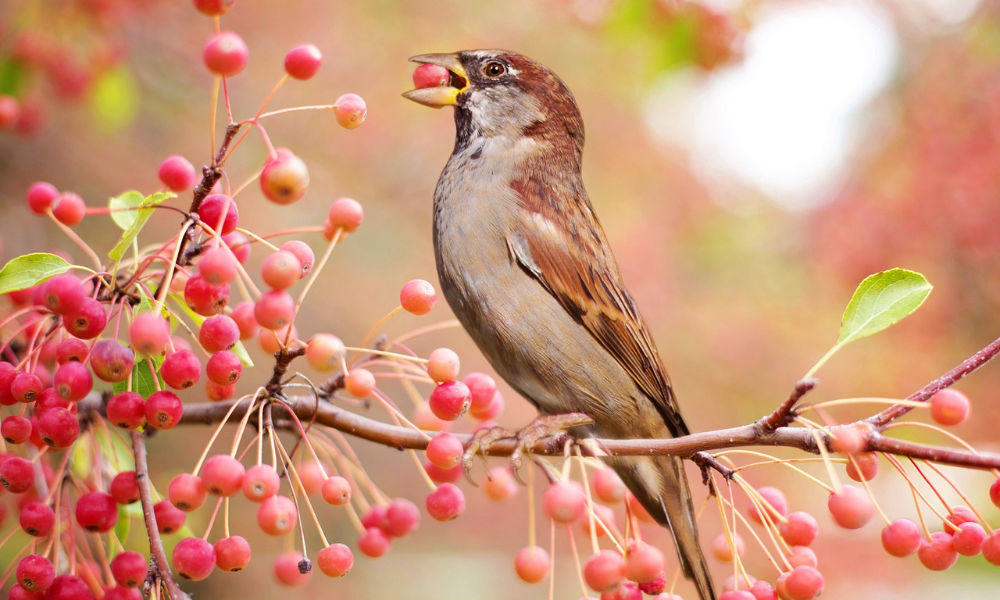
I sit under a rowan tree, the berries red “like a lipsticked girl”, in the words of Seamus Heaney. I think of the image of the tree of Yoga, the fruit of which symbolises Samadhi. This morning two birds perched on the branches, and one enjoyed a few berries while the other looked on, and it brought to mind the archetypal image in the Upanishads of the ego and the Atman, one immersed in the world and the other the witness.
The garden is surrounded by Druid trees: rowan, birch, alder, ash, and hazel. One side is bordered by a river, where a heron fishes: patient, still and one-pointed, this solitary bird is a symbol of the meditator. The hazel is fruiting, with pale green nuts. The hazel is associated with wisdom, and in Celtic lore the nuts of wisdom dropped into a deep pool and were consumed by the salmon of knowledge. The fall of the nuts symbolises the descent of the spirit into matter, and the salmon in the deep pool is Kundalini Shakti, slumbering in the hollow of mooladhara chakra, awaiting the first rippling of the initiatory call of Yoga. “I went out to the hazel wood, because a fire was in my head” (W.B. Yeats).
Beyond my garden, a beautiful field extends to the horizon. I like to gaze across it, especially when the sun shimmers off the glossy unmown grass, and “ancient Ireland washes in, in all her unbaptised beauty” (Patrick Kavanagh). The light of the sun allows me to see the romp and play of the wind in the grass, “breezes following their young”; and yet it tells me that another greater Light allows me to know and enjoy the sunlight, and indeed is the source of the sun, “light upon light”. In the Bhagavad Gita, the body- mind is known as a field (kshetra) in which we sow and reap our karma. The witnessing Self is “the knower of the field”. Sometimes, the gazing over the outer field becomes a gazing over the inner, and a question arises, the answer already contained in its kernel, “who indeed is the one who gazes?”
Autumn is of course associated with harvest and with bounty, with reward for work, with gratitude to the giver, and with the keeping over of seeds for next year’s planting. Naturally, it is associated with rite and ritual, with celebration and sacrifice. The word “rite” has its roots in the Sanskrit “rita” which means “order”, often pertaining to cosmic order, or dharma. At the heart of rita is sacrifice (yajna). Rites maintain the cosmic order, and this includes the rotation of the seasons and the balance of the environment.
Yogic wisdom, particularly the Bhagavad Gita, reminds us that if we remove the sense of ritual, and sacrifice, from our lives, then the environmental ambience is disturbed, which is what we are seeing today. Karma Yoga is a natural way to play our mandatory part in turning the wheel of dharma, with its emphasis on offering up, as a sacrifice, the fruit or harvest of our actions- including our Yoga practice. Everything we do in life can then become a ritual. “Food is the life of all beings, and all food comes from rain above. Sacrifice brings the rain from Heaven, and sacrifice is sacred action”. (Bhagavad Gita, 3:14).
Autumn also marks the third part of the sun’s journey and the third part of life, a time of inner reflection, of retirement, of preparation for the spiritual journey. Self-study (swadyaya), meditation, and reading of the scriptures become increasingly important. In India this period of life is traditionally associated with the renunciation of household duties and retirement to an ashram, or the embarking upon a pilgrimage. The glorious colours of autumn foliage symbolise the donning of the raiment of wisdom, so necessary in the autumn of our life.
The seasons of course are cyclical, and in the East, and for the Celts, were signs of the eternal recurrence of life and the samsaric journeying of the soul (jiva). In Hindu mythology, the seasons and indeed everything in the here- below, move to the rhythm of Nataraja, Lord of the Dance, just like the migratory swallows now swooping joyfully through the sky above me. For this reason, the scriptures exhort us to make the best of our time, to discover our life’s purpose, and to evolve spiritually in this world. Seasons come and go, and the dance continues, but behind it all is Peace and the unchanging Reality, and it is this which we must seek and eventually find.
Om Shanti.
The Human Singing Bowl
In the beginning, the present, the future, and transcending time itself, is the Primordial Mantra OM.
It vibrates in everything: the crashing of waves, the song of birds, the words of poets and lovers, the crying of babies, the pulsation of the heart; even the merest pebble throbs with the sacred sound: otherwise, it would not exist.
OM throbs eternally in our hearts as the ‘unstruck sound’ (anahata).
We are woven out of vibration and that vibration is in essence sound. At its highest level that sound (Nada) is beyond hearing, but it descends to the here below in the sonic vibrations that enter the ear and are transmitted to the brain.
Our physical and psychic structure is designed to receive and to transmit sound, and the summit of this is the articulation of the sound that takes us to the shores of Silence: OM.
The delicate architecture of the human mouth and vocal cords facilitate the spiralling upwards of the Pranava AUM. A: guttural from the throat; U (pronounced O) reverberating at the palate: M: vibrating at the teeth and lips; and then we nasalise the sound so that it vibrates at the cranium with a buzzing ‘Nngg’ sound, akin to the prolongation of the final syllables of words such as ‘song’ or indeed ‘gong’.
This final mechanism ensures the vertical spiralling of sound and thus the Pranava is known as the ‘udgita’ the ‘ascending song’.
In the final phase we can ‘retroflex’ the tongue curling it backwards against the soft palate, the mobile tongue acting like the mallet of a singing bowl or gong.
We are indeed human ‘singing bowls’.
Bone conduction allows the sound to vortex around the inside of the body, especially when we apply a perennial lock such as ashwini mudra or moola bandha, so that the vibrations echo off the diaphragmatic chambers.
The sound may travel outwards like a sacred pebble tossed into the shoreless lake of the mind; or upwards to the psychic chakras and bindus that shine like a distant constellation above the normal reaches of consciousness.
The singing bowl used in Yoga or Tibetan Buddhism works in a similar manner, playing on our nadis and chakras to bring us to states of meditation or awareness.
The bowl and mallet call to mind two sacred symbols of yogic ritual, the female Yoni and the male Lingham.
These symbolise respectively the Divine Creative Energy of Shakti, and the Pure Consciousness of Shiva, which together create the endless song of creation.
Invert a bell and its tongue and you have the same archetype. The bell that calls us for sacred ritual or meditation.
The yogic scriptures urge us to let go of our ego and to become instruments of the Divine, whether it be the Devi Saraswati whose veena plays upon the strings of the nadis; or Lord Krishna who invites us to become open and empty like the holes in his flute.
There is something about a resting singing bowl that imparts that same sense of receptivity and humility. In turn, it invites us to adopt the same attitude in our lives.
May we all become singing bowls of the Divine and follow the sound that leads to the Silence of the Heart.
Om Tat Sat.
Header image of bird by Jill Wellington from Pixabay
 Swami Nishchalananda
Leave a comment