
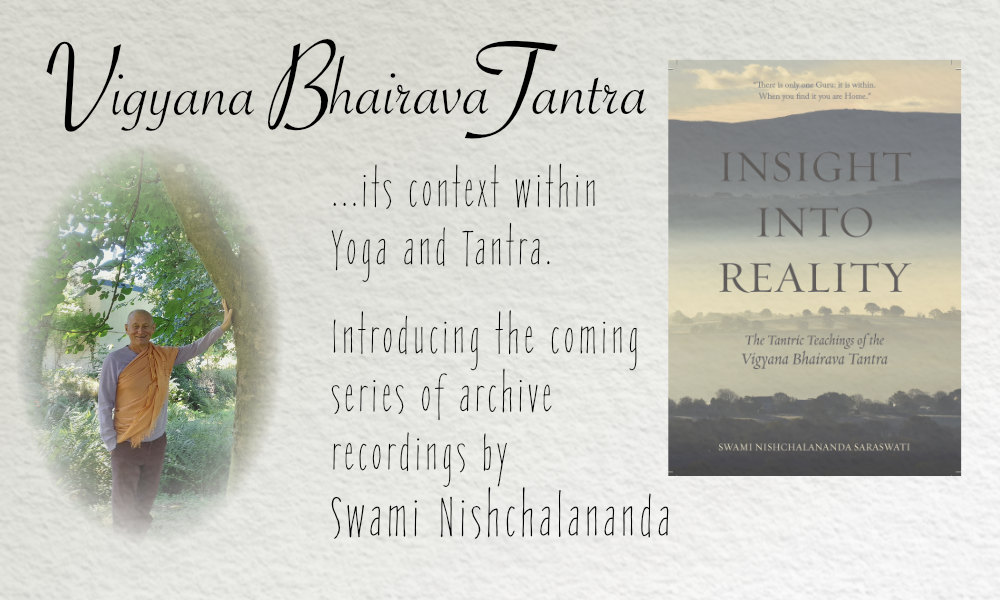
A series of recordings taken from some of Swami Nishchalananda’s discourses on the Vigyana Bhairava Tantra, will be coming to the blog very soon.
We decided it would be useful to explain a bit about how the concepts and practices fit into the landscape of Yoga and Tantra as practiced in today’s world, as well as understanding how, historically, it arose in Kashmir.
An introduction from Swami Nishchalananda
There is One Reality behind every person, every creature – everything. The teachings of the Vigyana Bhairava Tantra1 are designed to open our hearts, minds and being to this Reality. Though very earthy and practical, they are based on Advaita (Non-dualism). Advaita is not intended to try to explain Reality (as in western philosophy) but rather to point the finger at the direct realisation of It. The Vigyana Bhairava Tantra gives us the practical tools.
These teachings do not require us to escape the world. Instead, they help and encourage us to deepen our understanding and experience in our day-to-day life situations. The practices can directly promote meditation in your daily life.
Swami Nishchalananda
These recordings will introduce you to practices that can directly promote meditation in your daily life. Their aim is to give you answers in your own experience. Direct perception removes doubt so that there are no questions. Spiritual life is not about debate but communion.
The Vigyana Bhairava Tantra (VBT) is an important text of Kashmir Shaivism and introduces us to Advaita as it was evolved in Kashmir. All of the techniques are non-moralistic and non-religious but orientated to spiritual understanding. Broadly speaking, they aim to create a sense of spaciousness and a meditative state in moment-to-moment daily situations.
Existence, including our own
existence, is far more mysterious
and miraculous than we think,
and indeed, more extraordinary
than we are able to think.
Meditation requires no technique; it is spontaneous, but first of all you have to be on the point of being spontaneous. Here in the VBT are practices which help to remove blockages to spontaneity; they prepare the ground. We cannot become joyful by wanting, grabbing, or excessive effort; joy and insight are a by-product of being receptive. The practices provide us with the means of creating a space inside for the flowering of abundant energy, insight and wisdom.
The Contemporary Context
(by Narada)
The Sanskrit word ‘dharana’ literally means ‘to hold on to’ or ‘to concentrate’. In yoga and tantra, it has different meanings according to the specific teaching and path:
In Classical Yoga
This is generally considered to be the Eightfold Path, as elucidated by the sage Patanjali in the text Yoga Sutra2. Here the word means to concentrate the mind, usually on an object. This focus (dharana) when sustained over a period of time can lead to the experience of dhyana (meditation) and ultimately, samadhi (spiritual illumination). Most of us need time for the practice to develop. However, in the modern busy world most yoga practitioners just don’t have enough time. Moreover, the mind gets easily dispersed by extraneous thoughts, such that the focus is lost.
This system evolved in India more than a thousand years ago when serious practitioners had no problem finding time. But in the present era it has its limitations; there’s no doubt that concentration of the mind in this way is transformative, but for many of us, we simply don’t have enough time.
In the ‘Direct Path’
The teachings of Sri Atmananda are regarded as the origin of the term ‘Direct Path’. Apart from the classical definition of dharana (as above), he suggests a different interpretation of concentration which I find very worthy of reflection:
‘Examine the mind itself and discover that it is never distracted, since it can never take two thoughts simultaneously. To know this deeply takes you even beyond concentration, a long way towards Reality.‘3
The path proposed by Swami Nishchalananda
The following quote is taken directly from his book ‘Insight into Reality’4, which gives a translation and commentary on the Vigyana Bhairava Tantra:
‘Whilst respecting the root meaning of the word dharana, the dharanas (practices) of the Vigyana Bhairava have a different emphasis. Instead of ‘holding on to’ or concentrating on an object as such, each dharana asks us to hold onto the ‘essential quality’, ‘feel’, or ‘vibe’ of the present moment, of the now. Even if the dharana (practice) does specify an object or visualisation on which to focus the mind, of more concern is the ‘spaciousness’ in which the object or visualisation occurs. The spaciousness of each moment is more important than the contents or objects.‘
If we see the mind, and thoughts, feelings, even emotions to be ‘objects’ in the sense that they are things that are perceived by Awareness, then this is very similar in meaning to the lines from Sri Atmananda above. In both cases, it’s a most significant change in emphasis on the meaning of dharana (concentration).
So, what’s the point of all this?
a goal created in the mind
is destined to be never
reached, since it exists
only in the mind
Simple. Some of us feel like we have been pursuing a ‘goal’ defined for us by our interpretation of what we have been told by yoga teachers and yogic texts, and as such, a goal created in the mind that is destined to be never reached, since it exists only in the mind, the imagination.
Practices sometimes bring great peace and relaxation, also ‘spiritual’ experiences. But there may still be a lack of total ease and a sense of ‘being Home’, or identification with Awareness, of which texts like the Ashtavakara Gita5 talk. Often, our practice leads to the state of Being, or meditation, perhaps during Satsanga (group sharing, delving into the Truth of Being), but this quickly evaporates as we get involved in daily affairs.
you already are what
you are, which could
not be anything other
than Awareness
The Direct Path, a contemporary approach with a huge internet presence through the likes of Francis Lucille, Rupert Spira, Greg Goode et al. offers us a new approach in that it tells us ‘Look, you already are what you are, which could not be anything other than Awareness’. This is the starting point of realisation of the ‘I Am’ principle and identification with it.
The first time I encountered Direct Path teachings, they took my breath away with their shocking simplicity. But they can be very cerebral although different contemporary teachers do occasionally suggest different techniques that don’t involve using the mind to bypass the mind.
Reflection is very much as important as meditation practices. And both Direct Path and Vigyana Bhairava teachings have many reflective practices. But there are days when reflection is not what I want. Days when I don’t want to read or consider another’s ideas, however insightful they may be. All I want to do in my practice time is sit without thought.
One of the great things about the Vigyana Bhairava Tantra is its wealth of practices where one simply works with prana, and maybe chakras, where no thought is needed, simply doing the practice and allowing it to bring spaciousness therefore automatically, insight. (The wisdom of insight is not the wisdom of thinking, though insight must be interpreted through thought, in order to be communicated. )
To summarise, the dharanas (practices) of the Vigyana Bhairava Tantra have a mixture of cerebral (reflective) practices, Zen-type sudden insight practices, and many ‘simply doing’ practices generating a sense of Spaciousness, which can serve as a stepping stone to a core sense of Stillness as one’s unchanging identity.
And, most importantly, the dharanas enhance my waking, walking, seeing, hearing, experience of life, and sometimes even a return to childlike wonder. In this regard, it truly is a remarkable text and Swami Nishchalanada’s translation and commentary is clarity itself, insightful, and very comprehensive.
Brief introduction to Swami Nishchalananda:
As I started going through Swami Nishchalananda’s archive material to create this blog, I saw that decades ago he was using imagery which you find in the discourses of some contemporary Direct Path teachers. Imagery such as that of the movie screen, which sits unnoticed behind the action and noise of the movie playing out upon it. It is unseen, yet without it the movie could not exist.
And I’ll never forget the time when he showed complete disinterest in my raving on one day about a wonderful experience I’d had in meditation, merely saying, ‘What you are looking for is that which doesn’t change’. Even though that experience was timeless while I was in it, I realised he meant that it was just another ‘event’ on the timeline of my life. What a Direct Path teacher might call an ‘object’. A very nice one, but still an object.

Swamiji has Presence,
which is itself a teacher
When you listen to Swami Nishchalananda you don’t hear a ‘guru’, someone who possesses wisdom that you can only dream of. Sure, you hear someone who’s been around in the Yoga world, trained at a famous Yoga School in India and being acknowledged by them as a ‘Yogacharya’ (Master of Yoga), someone who taught Yoga all around India and since then has taught thousands of people from all around the world. Sure, he has a wealth of most valuable information about the traditions and practices of Classical Yoga, Advaita (Vedanta), Tantra and much more.
And he has Presence, which is itself a teacher.
But more than anything else, with Swamiji you get a fellow traveller, a brother. A brother who can remind you of your essential nature as Awareness just by being himself. I sometimes feel that I’ve had a rocky road on this journey of my ‘life with Yoga’; I’ve met a lot of self-important people who have hindered rather than helped me.
Now I am content.
Footnote:
Swamiji’s inspiration has helped and encouraged me to teach yoga in Zambia. People practise a beautiful simple Christianity; as such, it wasn’t appropriate for me to introduce chants and songs in Sanskrit or talk of Hindu traditions and ritual. My friends are more suited to the kind of ‘meditation’ that I prefer anyway: to be absorbed looking at a flower, to savour the feeling of joy in moments of friendship. A bit like some of the modern dharanas given in the supplementary practices of Swamiji’s book.
As someone who has practised inner contemplation for many years, what I and my friends in Yoga Zambia have found is that the practices of the Vigyana Bhairava Tantra, infused with influence of the Direct Path, are inspirational, practical and enjoyable on the path to Spiritual Realisation.
Narada (Tony Sugden)
References:
1 A source text of the tantric system of Kashmir Shaivism.
2 A classical text attributed to Sage Patanjali, the origin of the ‘Eightfold Path’ or Ashtanga Yoga.
3 Tripta, N. (2009), Notes on Spiritual Discourses of Shri Atmananda, Vol 1 p. 154, Salisbury, Non-Duality Press.
4 Swami Nishchalananda Saraswati, (2011), Insight into Reality, the Tantric Teachings of the Vigyana Bhairava Tantra, Llansadwrn, Mandala Yoga Ashram. The book also contains extensive references on all related concepts and practices; see ‘Books’ in the website header menu for details.
5 An ancient Sanskrit text which explains the teachings of gyana yoga, or Advaita (non-dualism), also known as Vedanta (the culmination of knowledge).
 Swami Nishchalananda
Leave a comment