
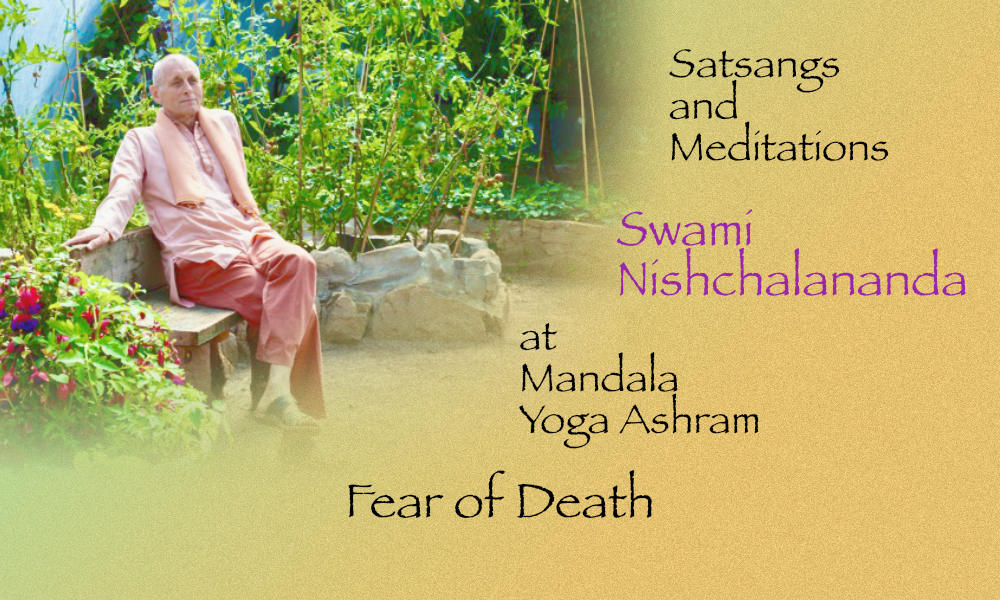
The fear of death arises from the fact that we live as individual egos. And in our individual life, we live in Time, a place of beginnings, and therefore endings.
Another in the series of 2004 discourses from Mandala Yoga Ashram in Wales, by the Founder Swami Nishchalananda Saraswati.
‘Why do we fear death?’
Firstly, Swami Nishchalananda points out that fear of death may be seen as a protective mechanism to ensure that we take care of our bodies, we don’t endanger them.
Also, consider this – we exist within Time. Therefore we know that because we were born at a point in time, so there will be an ending in time, death. And because we identify with the bodymind, we believe that our existence will end.
What makes you identify with a particular form?
Herein lies the fundamental question.
In Yogic philosophy there is a word for it, ‘Ahambhava’, ‘ the feeling of being I’. (The term ‘Ahamkara’ is more ‘I as the doer’). And although this identification with the individual bodymind is necessary for the survival and well being of that individual, Yoga teaches us that such identification is actually the result of strong conditioning. It does encourage bringing quality into our life and our physical functioning, but it also allows us through practice and experience to question that identification, to question the nature of our identity.
Intuition, realisation on the
Yoga path, suggests that maybe
the life of an individual is
a small part of a bigger picture,
that we are a part of a Totality.
So If you totally identify with the body, then naturally you will be scared of Death. You may adopt religious beliefs but they are just that, beliefs.
But Intuition, realisation on the Yoga path suggests that maybe the life of an individual is a small part of a bigger picture, that we are a part of a Totality.
The questioner also asked about fear of making mistakes. Swamiji suggested that what we might call mistakes are part of our development. Is it a mistake that a baby falls over when it’s learning to walk? We all make mistakes. In fact it’s an imperative if you want to learn.
Both the fear of dying, and the fear of making mistakes are there because we have an Egoic existence as individuals.
The Spiritual Quest: Living in the World
or living in an Ashram or Retreat.
The next question asks whether the ‘Spiritual Quest’ is the life a person leads, or a retreat away from the larger world? Keeping in mind that the questioner is staying at the ashram, which could be considered to be a retreat.
Swamiji acknowledges that the ashram is an ‘energy centre’ in some way. It gives people a lift, encourages practice and that inspiration they can often take home. Having said that, most of what happens in the ashram is not much different to life in the outside world. But for Yoga practitioners, not everyone can spend time at an ashram, but there’s no doubt that it can speed up the process of ‘deepening’ one’s practice. Having said that, in talking about living an ‘average life’ in the world outside an ashram environment, Swamiji makes the point, ‘There is no such thing as an ‘average’ life. Everyone’s life is average, and everyone’s life is extraordinary’.
Please enjoy the recording below

 Swami Nishchalananda
Leave a comment