
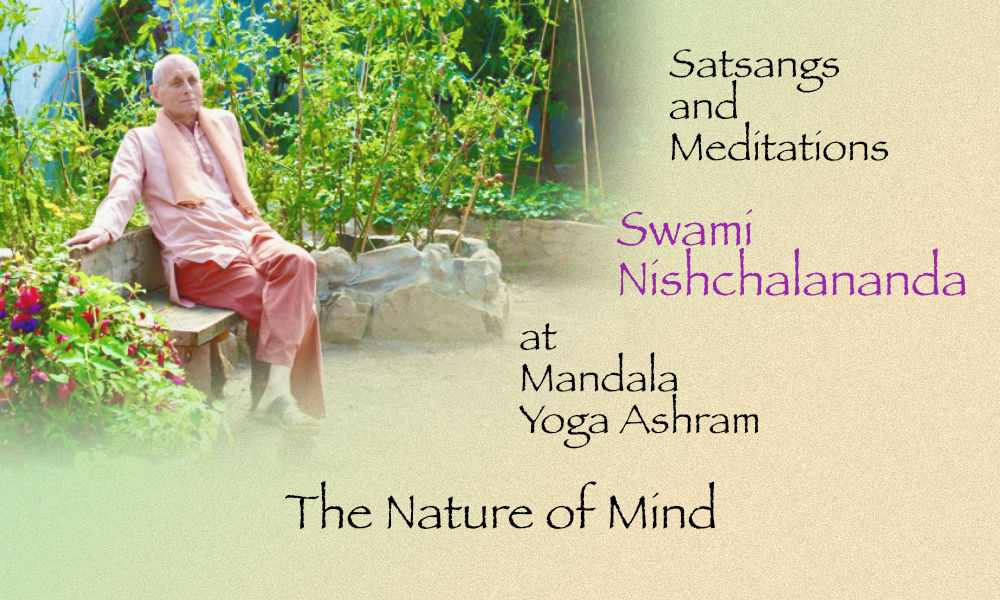
Is the Mind simply the ‘Ghost in the Box’, a neurological shadow, or is there more to it than that?
Another in the series of 2004 discourses from Mandala Yoga Ashram in Wales, by the Founder Swami Nishchalananda Saraswati.
‘What is the nature of the Mind?’
‘The Ghost in the Box’
Swamiji suggests this as the standard definition of the mind. Firing of nerve signals in the brain creating an abstract entity as it were. But he goes on to say that he completely disagrees with this representation. In Neurological terms, Swamiji’s suggestion is quite radical; he says, ‘The Brain, to me, is the motor organ that allows the mind to manifest’.
The Brain, to me, is the
Swami Nishchalananda
motor organ that allows
the mind to manifest
He uses examples such as flashes of perception, like telepathy for example, which are external to the individual, to demonstrate the possibility that Mind may well be outside the physical constraints of the body. But everyday life says that we have to live on a very physical level to live as human beings, and the society in which we are brought up tells us that the physical reality is the only one which is valid. What you see is what you get.
When we start on a ‘spiritual’ path such as Yoga, we are presented with experiences and situations which may shock us into a realisation that this picture of reality may not be as absolute as we thought. We cannot explain the totality of what we are through a completely materialistic interpretation.
A radical proposition from Swamiji; the Universe is Mind, and individual existences are little islands in this ocean of mind. He talks about the Quantum physics point of view (specifically quantum entanglement) to suggest that fixed dimensions of Time and Space are not actually the case, and such a concept as ‘Universal Mind ‘could only be in an environment where Time and Space were not absolute.
The idea of Space being another part of the material world existed millenia ago in Indian philosophy; the Sanskrit term ‘Akasha’ means Space as a subtle element, a ‘Tattwa’, not an absolute entity. But how can it be possible to comprehend Space as being a projection from another level of Reality?
How can we possibly comprehend Space as being a projection from another level of Reality?
Swami Nishchalananda uses the practice of ‘Spaciousness’ a lot in guided meditations. In a very real way, this makes it less of an issue whether such Spaciousness is ‘Real’ if we use that standpoint as a platform from which to observe thoughts, feelings etc.. All we need to see is that Spaciousness is on a different level than the usual buzzing activity within the mind, and although it may be a more subtle mental construct in itself, it is nonetheless a reflection of a more fundamental level of Reality. We all know those moments where there is a real sense of a greater space, a knowing which is not intellectual but on some more basic level. And even though we may have to dive back into the world of concerns and things we have to do as part of our lives, each contact with that greater spaciousness has resonated and registered it’s presence with us. It becomes easier to know that the mental noise is in fact ‘an ongoing flow of energy which is the personal mind.’
And of course, Yoga is about accessing that Spaciousness so it becomes easier to acknowledge it, feel it, even when we’re ‘going through’ something.
Please enjoy the recording below

 Swami Nishchalananda
Leave a comment