
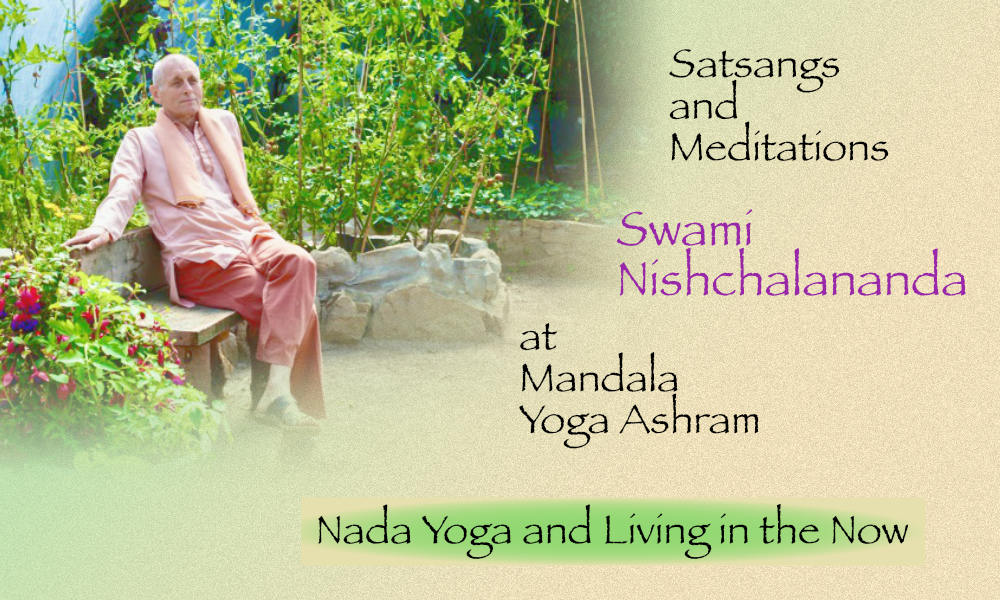
A question and answer session at Mandala Yoga Ashram in 2004 on the subjects of Nada Yoga, then, living in the moment and the acceptance that it brings.
‘What is difference between Shabd (Shabda) Yoga and Nada Yoga?’
Swamiji explains that they are essentially the same. Shabdha Brahman means Total Intelligence, manifesting as the Word, or better ‘Logos’, as in the Bible, ‘In the beginning was the Word’. This represents the manifest universe as vibration (from which all things are made). Nada is a word also meaning that primordial vibration. It’s a word used more commonly that Shabda, otherwise they have the same meaning.
Swamiji goes on to talk of the transformational effect of external vibrations of sound, words and especially music. And of course we see this in Mantra Yoga. But there is a difference between Mantra Yoga and Nada Yoga. Nada is subtle vibration, Nada Yoga is the tuning in to that vibration. through many different kinds of Yoga. He says that any means that allow a tuning in to Nada, subtle vibration, can be used. Mantra Yoga is using external sound to awaken perception of Nada.
Like Spaciousness, we are not creating anything, but becoming aware of that which already exists. Nada and Spaciousness are part of that same essential level of being. We simply tune in to a vibration which is already there. And if we do that we awaken chakras, especially Anahata and Agya, and greater insight is there.
Most human beings respond to music. So that can be used to awaken sensitivity to Nada, but also Mantra as sound vibration can allow the person to tread the same path as others before them, in other words we are tapping into the world of archetypes and the Insight available there.
Mantra as sound vibration
can allow the person
to tread the same path
as others before them
Swamiji uses as an example, the Gayatri Mantra. This mantra has been chanted in India for thousands of years. It raises the most interesting point that an awakening of wisdom, or insight, through this mantra, has created that understanding within the ‘Realm’ of the Collective Unconscious which then becomes available to anyone who travels that same road. And such a realm is beyond dimensions of space and time.
All the senses have a more subtle aspect. The subtle sense of hearing can be developed to become aware of Nada. Swamiji explores this relationship of the senses not only to the outside world, but also to the more subtle world. He makes a distinction between using the term ‘inner’ as opposed to a ‘more subtle’ level. Even the world of dreams is explored; where do dreams occur? We assume they are inner, meaning a deeper part of the personality, but is this true?
After the exploration of Nada, a question about the value of living in a quiet sheltered environment. It can be helpful if one becomes more sensitive when starting to practice Yoga. But it’s also very useful to live in society, where many people are living an egocentric life, without being badly affected. The practice of Yoga definitely can develop this ability to live like this. Vairagya, (usually translated as dispassion or detachment), in this context means to accept whatever life brings, quiet environment or noisy, and learn from it or at least be open to whatever arises.
This becomes the main point of the answer; that by living in the moment and accepting what it brings, we do not lose our energy needlessly. But that doesn’t mean we have to put up with situations where we don’t feel right. In other words we have to accept our own feelings also and respond to them as we feel appropriate. Swamiji gives an example which I am sure we all know: Someone wants to talk and at first it’s fine, you have a good conversation, but then it has run it’s course but the other person wants to keep talking when you’re talked out. If you continue, thinking that you must accept what the situation is bringing, it will probably have a draining effect on your energy. There’s a lot behind this which is why Swamiji is really pressing the point; to do what is appropriate takes sensitivity to everything in the environment, which includes your own feelings and thoughts.
Please enjoy the recording below

 Swami Nishchalananda
Leave a comment